

Air/Pressure Testing vs. Fluorescent Leak Detection
Advantages and Limitations
n the quality control of welded structures, pressure testing (Air/Pressure Test) is one of the oldest and most widely used leak detection methods. However, with advances in inspection techniques, fluorescent leak detection has emerged as a complementary or alternative option. In this article, we compare these two methods in terms of mechanism, accuracy, and application.
How Do They Work?
Pressure Testing (Air/Pressure Test): The tank or structure is fully sealed and pressurized internally with air or gas. If a leak exists, the pressure drop shows on the gauge, or by applying soapy water to the surface, bubbles appear at the leak location. This method requires the structure to be completely sealed.
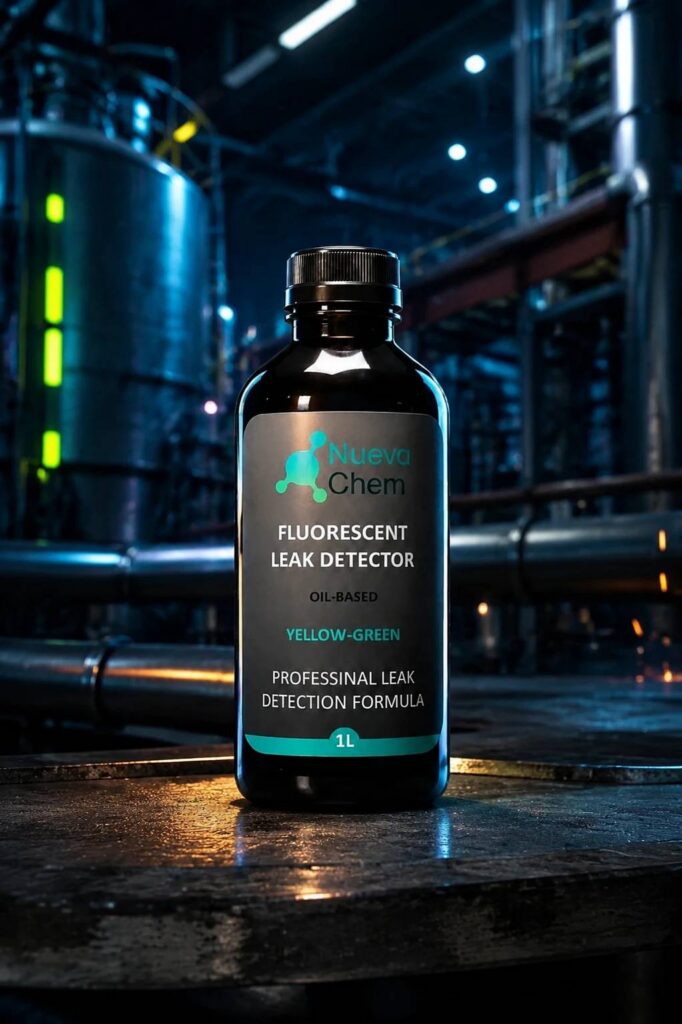
Fluorescent Leak Detection: A fluorescent liquid is sprayed onto the weld surface and penetrates pores through capillary action. The exact leak location is identified under UV light as a yellow-green glow. This method requires no sealing or complex preparation of the structure.
| Criterion | Pressure Testing | Fluorescent Leak Detection |
|---|---|---|
| Structure sealing required | Yes (complete) | No |
| Precise leak location identification | Limited | Accurate |
| Sensitivity to very fine leaks | Moderate | High |
| Special equipment needed | Pressure device/gauge | UV lamp |
| Applicable on unfinished structures | No | Yes |
| Inspection speed | Moderate | Fast |
| Execution cost | Moderate | Low |
| Safety | Caution required (pressure) | High |
Where Does Each Method Have the Edge?
Pressure testing is most suitable when the structure is fully built and ready, and the goal is final confirmation of the entire system’s seal integrity as a unified unit. This method can confirm the overall presence or absence of a leak, but doesn’t always pinpoint the exact leak location clearly.
Fluorescent leak detection has the advantage when the goal is to identify the exact location of leaks in specific welds, or when inspection is carried out on a structure that isn’t fully assembled yet or cannot be completely sealed. It can also be performed during periodic in-service inspections without requiring a complete system shutdown.
Competitors or Complements?
In industrial production lines (such as transformer tank manufacturing), these two methods are often used as complements at different stages of production: the fluorescent method is used during intermediate production stages to identify and correct weld defects, while pressure testing is performed at the final stage as an overall seal verification. This combination guarantees both precise local defect detection and confidence in the overall structural integrity.
Conclusion
Pressure testing and fluorescent leak detection are both valid tools in welded structure inspection. Pressure testing provides overall seal confirmation, while the fluorescent method pinpoints the exact location of defects. Using both together gives manufacturers the most comprehensive inspection coverage available.