

چگونه نشتیهای جزئی میتواند منجر به شکستهای بزرگ در سازههای فولادی جوشکاری شده شود
In structural engineering, a well-known principle holds: major failures almost always start from small points. In welded steel structures, these small points are often the same hairline cracks and fine pores that went unnoticed during manufacturing. Understanding the mechanism by which a fine leak becomes a major failure is key to appreciating the importance of thorough inspection at the production stage.
The Crack Propagation Mechanism: From Micro to Macro
When a hairline crack forms in a weld, it isn’t immediately dangerous. But over time, several factors act on it simultaneously:
Mechanical Fatigue: Industrial steel structures are typically subjected to cyclic loading; pressure cycles, machinery vibration, or temperature fluctuations. Each loading cycle opens the crack slightly further. This process, called “fatigue,” can transform a microscopic defect into a visible crack over months or years.
Corrosion at the Crack Point: Water, moisture, or chemicals that penetrate the crack can initiate a corrosion process at that very point. Corrosion eats the metal from within and accelerates crack growth; a combination known as “Stress Corrosion Cracking,” one of the most destructive failure mechanisms in steel structures.
Stress Concentration: The tip of a crack is where mechanical stresses concentrate. The longer the crack grows, the greater the stress concentration at its tip, and the rate of crack propagation increases exponentially.
A Real-World Scenario: Industrial Steel Tank
Consider a welded steel tank in an industrial unit. At the time of manufacturing, a small weld defect exists in one of the tank’s vertical seams, undetected during routine visual inspection. In the first year of operation, cyclic internal pressure slowly propagates the crack. In the second year, ambient moisture penetrates the crack and corrosion begins. By the third year, the crack has grown to the point where the tank wall in that area is significantly weakened. On a day when internal pressure peaks, the wall yields at that exact point. The result: sudden tank failure, emergency unit shutdown, and repair or replacement costs several times greater than the cost of a simple inspection at the time of manufacturing.
Why Do Fine Leaks So Often Go Unnoticed?
Initial invisibility: Hairline cracks in their early stage are too fine to be detected by the naked eye or routine visual inspection.
Slow leakage: Initially, the leak is so slow that it produces no visible signs (such as droplets on the surface).
Surface coating: Paint or anti-corrosion coating on the surface can conceal the underlying crack.
Fluorescent Inspection: Seeing What the Eye Cannot
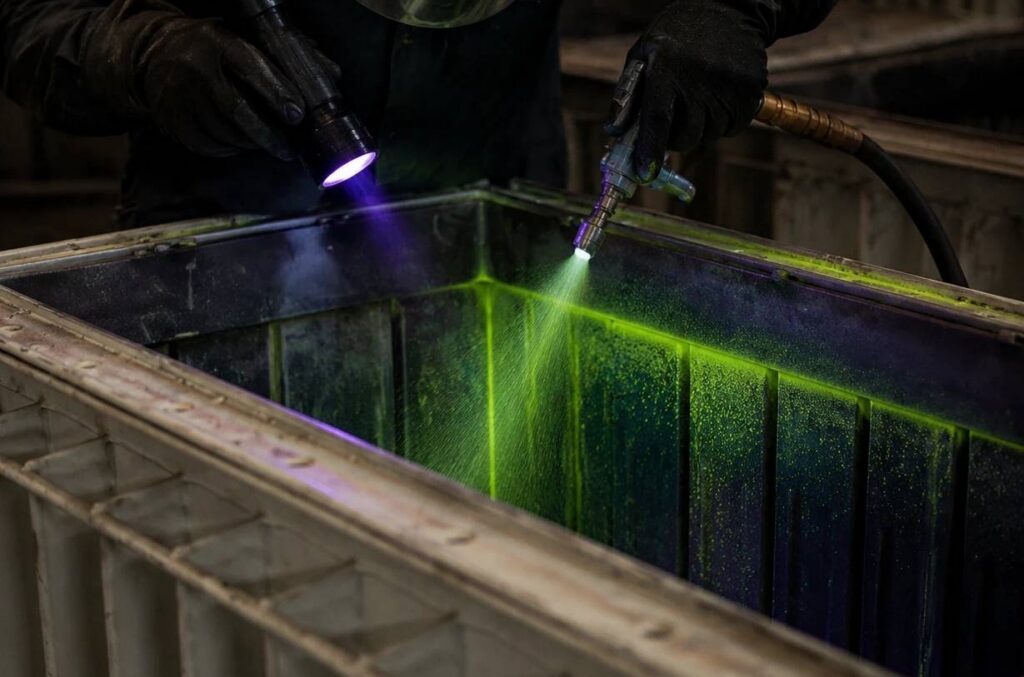
The fluorescent leak detection method is designed precisely for this stage; identifying those hairline cracks while they are still small, still easily repairable, and have not yet developed into major failures. Identifying and repairing a fine crack at the production stage is exactly the point at which the failure chain can be broken before it begins.
نتیجهگیری
Major failures in steel structures are neither rare nor unpredictable; they are the foreseeable result of overlooking small leaks in the early stages. Thorough inspection at the production stage is the simplest and least costly way to prevent this failure chain.