


The Importance of Leak Testing in Transformer Tank Manufacturing
The Importance of Leak Testing in Transformer Tank Manufacturing
Transformers are among the most critical equipment in power distribution networks. Their useful life is typically estimated between 20 and 40 years, but a small leak in the tank can significantly shorten this lifespan, even if it’s completely invisible at first.
Why Does a Transformer Need a Sealed Tank?
The insulating oil inside a transformer tank serves two vital roles: electrical insulation (preventing short circuits between windings) and cooling (transferring generated heat to the environment). A drop in oil level affects both functions simultaneously. For this reason, complete tank sealing is not an optional quality requirement but a prerequisite for the safe and proper operation of the transformer.
A Real-World Scenario
Imagine a distribution transformer installed in an industrial area. At the time of delivery, no visible leak exists. But in one of the lower welds of the tank, a tiny hairline crack went undetected during routine inspection. In the first months, the leak is so slow that not even a drop appears on the ground; only the oil level quietly drops. After 12 to 18 months, the oil level has fallen enough that cooling performance declines. On a hot summer day, winding temperatures exceed the allowable limit and the internal insulation is damaged. The result: complete transformer failure, a regional power outage, and equipment replacement costs — all caused by a tiny crack that could have been identified and repaired with a simple inspection on the production line.
At What Stage of Production Should Leak Testing Be Performed?
Leak inspection of transformer tanks is recommended at two key stages:
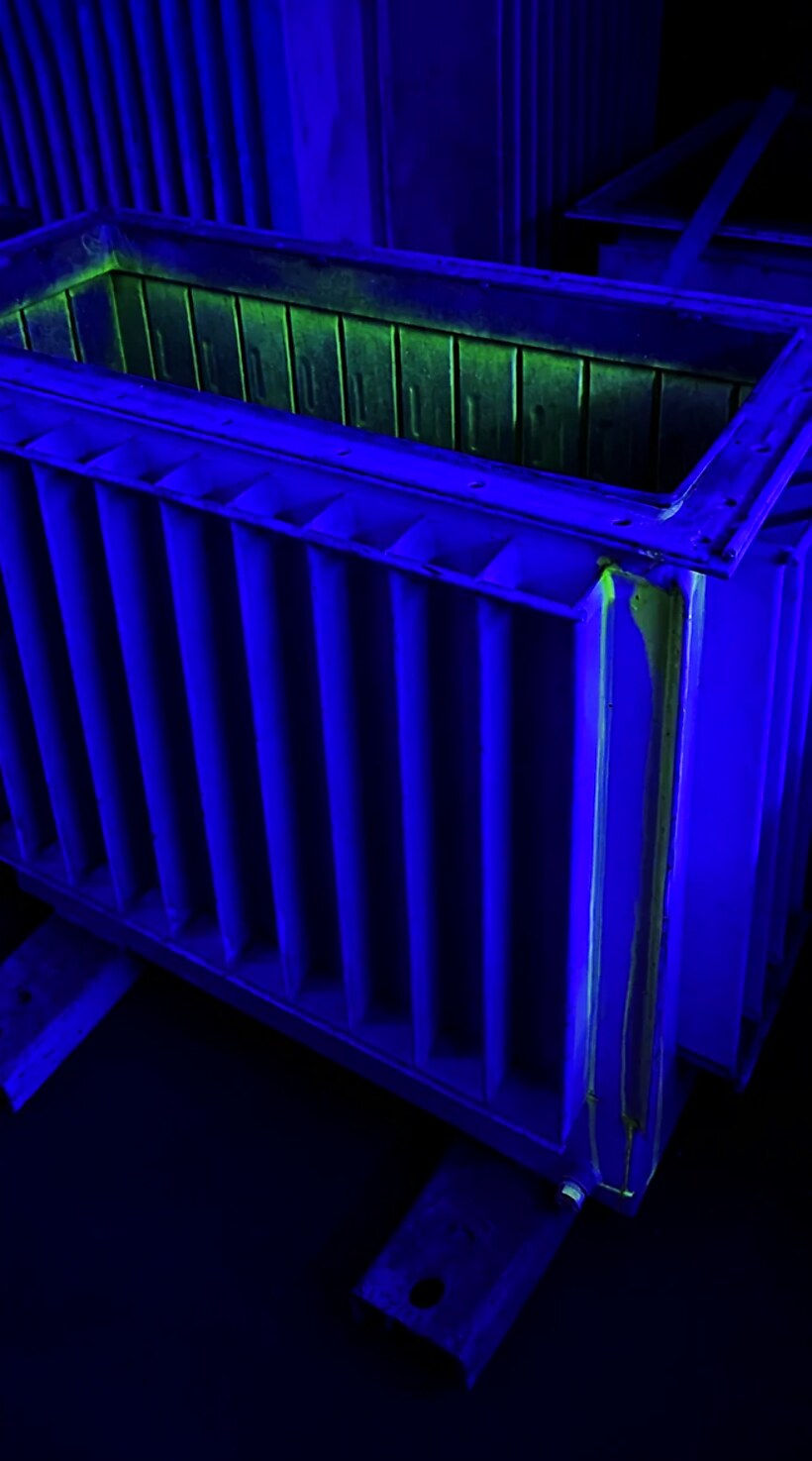
Stage One — After Welding and Before Painting: This is the best time for leak testing; the weld surface is still fully accessible, no protective coating has been applied, and if a defect is found, repair is quick and inexpensive.
Stage Two — Before Final Delivery: A final inspection after complete assembly ensures that no defects were introduced during later production stages (such as fitting installation or piping).
The Role of Fluorescent Leak Detector in This Process
The fluorescent method is an ideal option for quality control on transformer tank production lines due to its fast execution, high sensitivity in detecting hairline cracks, and minimal surface residue (which prevents contamination of the insulating oil). Unlike pressure testing, which requires the structure to be completely sealed, the fluorescent method can be performed at intermediate production stages, before the tank is fully completed.
Sonuç
For transformer tank manufacturers, leak testing on the production line is not an added cost but an investment in the reliability and quality of the final product. Identifying and repairing a hairline crack in the factory is always less costly than repairing or replacing a defective transformer in the field.