


The Science Behind Fluorescent Leak Detection
How Does Leak Detector Liquid Work?
If you’ve ever wondered how a simple liquid can reveal the tiniest hidden leaks in a metal weld, the answer lies in two scientific phenomena: capillary penetration and fluorescence. This article breaks down the science behind industrial fluorescent leak detectors in plain language.Where Do Weld Leaks Come From?Despite high precision, welding is never entirely defect-free. Air bubbles, porosity, cold or hot cracks, and incomplete weld penetration can create microscopic pathways deep within the metal. These pathways are often so fine that they go undetected by the naked eye or even careful visual inspection. However, under pressure or fluid exposure (such as transformer oil), these tiny pathways can gradually develop into real leaks.Stage One: Capillary PenetrationLeak detector liquid is formulated with low surface tension, a property that allows it to penetrate cracks and fine pores through capillary action alone, without requiring external pressure. The lower the liquid’s surface tension, the better its ability to enter narrower gaps. This is why precise formulation plays a decisive role in the sensitivity and accuracy of detection.
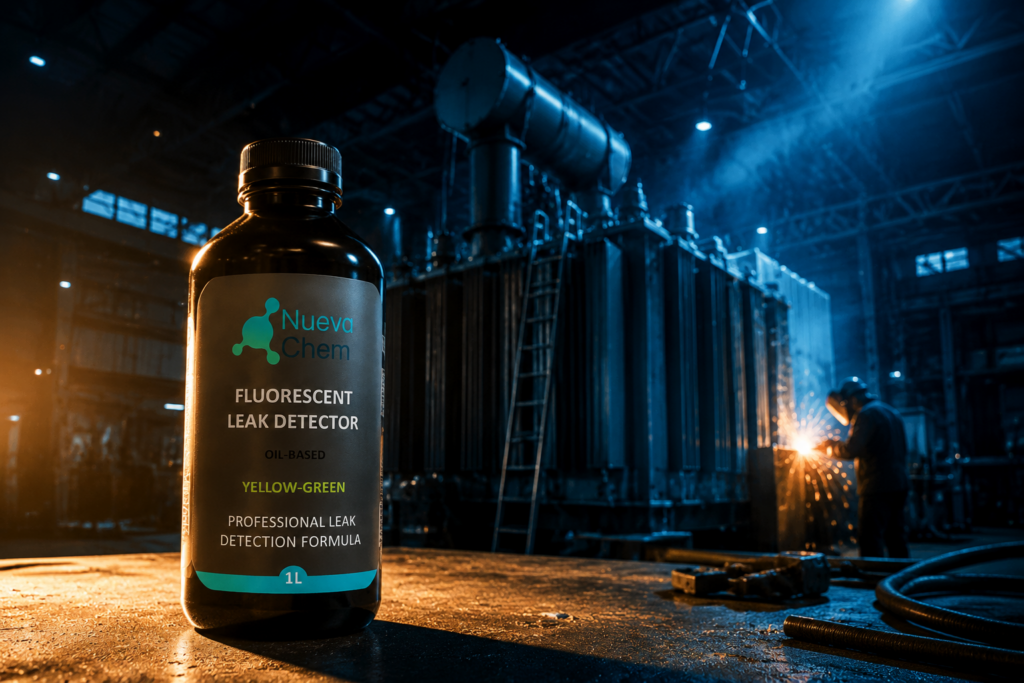
Once sprayed onto the surface, the liquid enters the weld defect and, depending on the exact location and angle of the flaw, seeps out to the opposite surface (or the same damaged area) within a specific time frame.Stage Two: Fluorescence and UV LightThis is where the liquid’s fluorescent property comes into play. The fluorescent compounds in the formulation absorb ultraviolet (UV) light and re-emit it at a different wavelength, typically within the visible range. This causes even a minute amount of liquid that has seeped out of a microscopic leak to become clearly visible under UV light as a glowing yellow-green spot or line, a spot that would likely go completely unnoticed under normal light.
It is this combination of deep penetration and visible glow that makes fluorescent testing one of the most sensitive non-destructive methods for detecting leaks in welded structures.Why Does This Method Matter for Critical Industries?In industries such as transformer tank manufacturing, even a microscopic leak can lead to insulating oil loss, reduced performance, or costly equipment failure over time. Thanks to its high sensitivity in detecting fine defects and the ability to perform rapid visual inspection under UV light, the fluorescent method offers an efficient and cost-effective quality control solution for these industries.